Auteur de la section : Danielle J. Navarro and David R. Foxcroft
Assumption checking
As with one-way ANOVA, the key assumptions of factorial ANOVA are homogeneity of variance (all groups have the same standard deviation), normality of the residuals, and independence of the observations. The first two are things we can check for. The third is something that you need to assess yourself by asking if there are any special relationships between different observations, for example repeated measures where the independent variable is time so there is a relationship between the observations at time one and time two: observations at different time points are from the same people. Additionally, if you are not using a saturated model (e.g., if you have omitted the interaction terms) then you are also assuming that the omitted terms are not important. Of course, you can check this last one by running an ANOVA with the omitted terms included and see if they are significant, so that is pretty easy. What about homogeneity of variance and normality of the residuals? As it turns out, these are pretty easy to check. It is no different to the checks we did for a one-way ANOVA.
Homogeneity of variance
As mentioned in subsection Checking the homogeneity of variance
assumption, it is a good idea to visually
inspect a plot of the standard deviations compared across different groups /
categories, and also see if the Levene test is consistent with the visual
inspection. The theory behind the Levene test was discussed in that section,
so I will not discuss it again. This test expects that you have a saturated model
(i.e., including all of the relevant terms), because the test is primarily
concerned with the within-group variance, and it does not really make a lot of
sense to calculate this any way other than with respect to the full model. The
Levene test can be specified under the ANOVA Assumption Checks →
Homogeneity Tests option in jamovi, with the result shown as in
Fig. 175. The fact that the Levene test is non-significant means
that, providing it is consistent with a visual inspection of the plot of
standard deviations, we can safely assume that the homogeneity of variance
assumption is not violated.
Normality of residuals
As with one-way ANOVA we can test for the normality of residuals in a straightforward fashion (see Checking the normality assumption). It is generally a good idea to examine the residuals graphically using a QQ-plot (see Fig. 175).
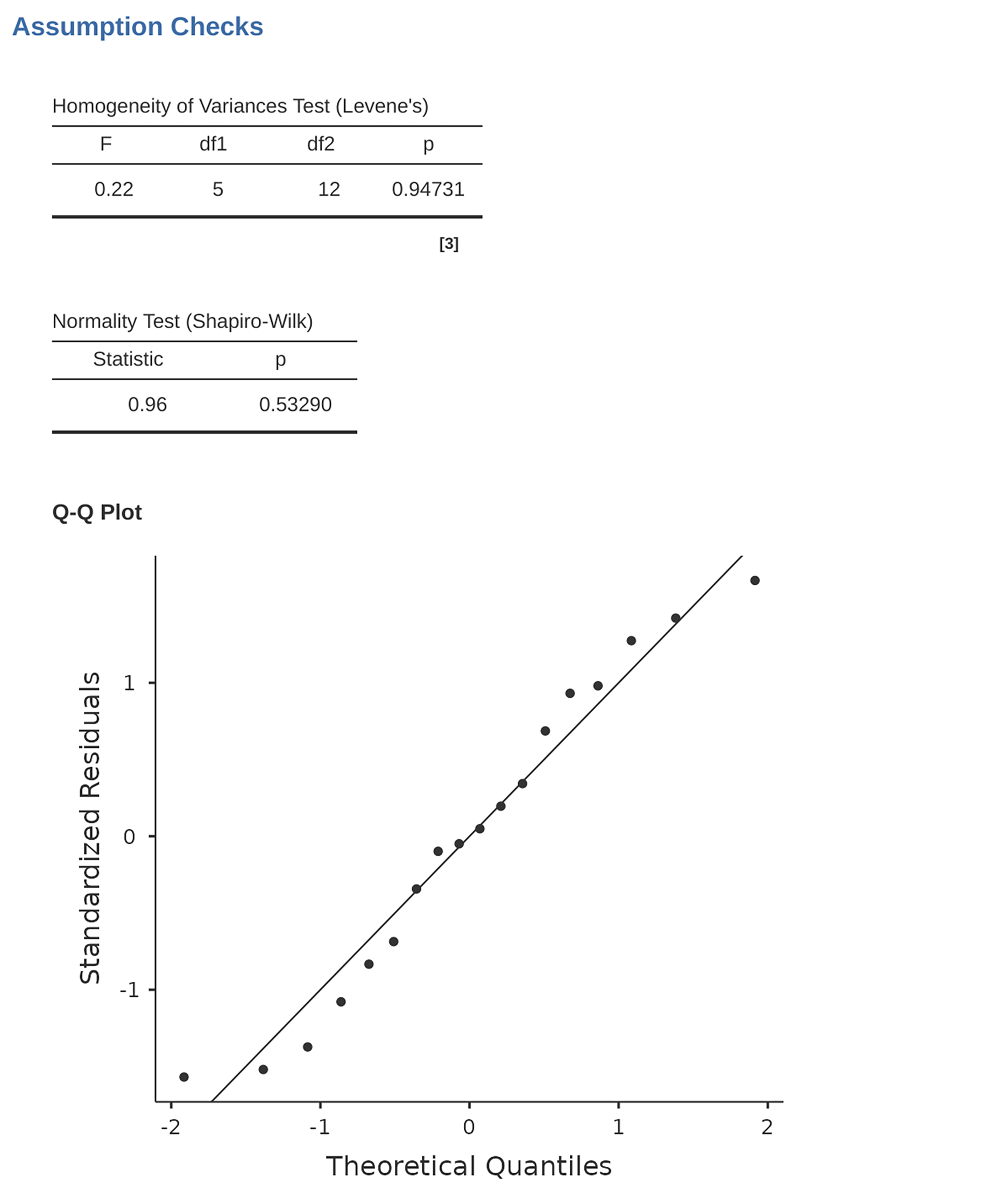
Fig. 175 Checking assumptions in an ANOVA model