Auteur de la section : Danielle J. Navarro and David R. Foxcroft
Analysis of Covariance (ANCOVA)
A variation in ANOVA is when you have an additional continuous variable
 that you think might be related to the dependent variable. This
additional variable can be added to the analysis as a covariate, in the aptly
named analysis of covariance (ANCOVA). In ANCOVA the values of the dependent
variable are “adjusted” for the influence of the covariate, and then the
“adjusted” score means are tested between groups
that you think might be related to the dependent variable. This
additional variable can be added to the analysis as a covariate, in the aptly
named analysis of covariance (ANCOVA). In ANCOVA the values of the dependent
variable are “adjusted” for the influence of the covariate, and then the
“adjusted” score means are tested between groups  in the usual way.
This technique can increase the precision of an experiment, and therefore
provide a more “powerful” test of the equality of group means in the dependent
variable. Although the covariate itself is typically not of any experimental
interest, adjusting for the covariate can reduce the error variance, and
thereby increase precision. This means that a failure to inappropriately reject
the null hypothesis (Type II error) becomes less likely.
in the usual way.
This technique can increase the precision of an experiment, and therefore
provide a more “powerful” test of the equality of group means in the dependent
variable. Although the covariate itself is typically not of any experimental
interest, adjusting for the covariate can reduce the error variance, and
thereby increase precision. This means that a failure to inappropriately reject
the null hypothesis (Type II error) becomes less likely.
Despite this advantage, ANCOVA runs the risk of undoing real differences
between groups , and this should be avoided. Look at
Fig. 176, for example, which shows a plot of Statistics anxiety
against age and shows two distinct groups – students who have either an Arts or
Science background. ANCOVA with age as a covariate might lead to the conclusion
that statistics anxiety does not differ in the two groups. Would this conclusion
be reasonable – probably not because the ages of the two groups do not overlap
and analysis of variance has essentially “extrapolated into a region with no
data” (Everitt, 1996).

Fig. 176 Plot of Statistics anxiety against age for two distinct groups
Clearly, careful thought needs to be given to an analysis of covariance with distinct groups. This applies to both one-way and factorial designs, as ANCOVA can be used with both.
Running ANCOVA in jamovi
A health psychologist was interested in the effect of routine cycling and
stress on happiness levels, with age as a covariate. Open the ancova data set
in jamovi and then, to undertake an ANCOVA, select Analyses → ANOVA →
ANCOVA to open the ANCOVA analysis window (Fig. 177). Highlight
the dependent variable happiness and transfer it into the
Dependent Variable text box. Highlight the independent variables stress
and commute and transfer them into the Fixed Factors
text box. Highlight the covariate age and transfer it into the
Covariates text box. Then, click on Estimated Marginal Means to bring
up the plots and tables options.
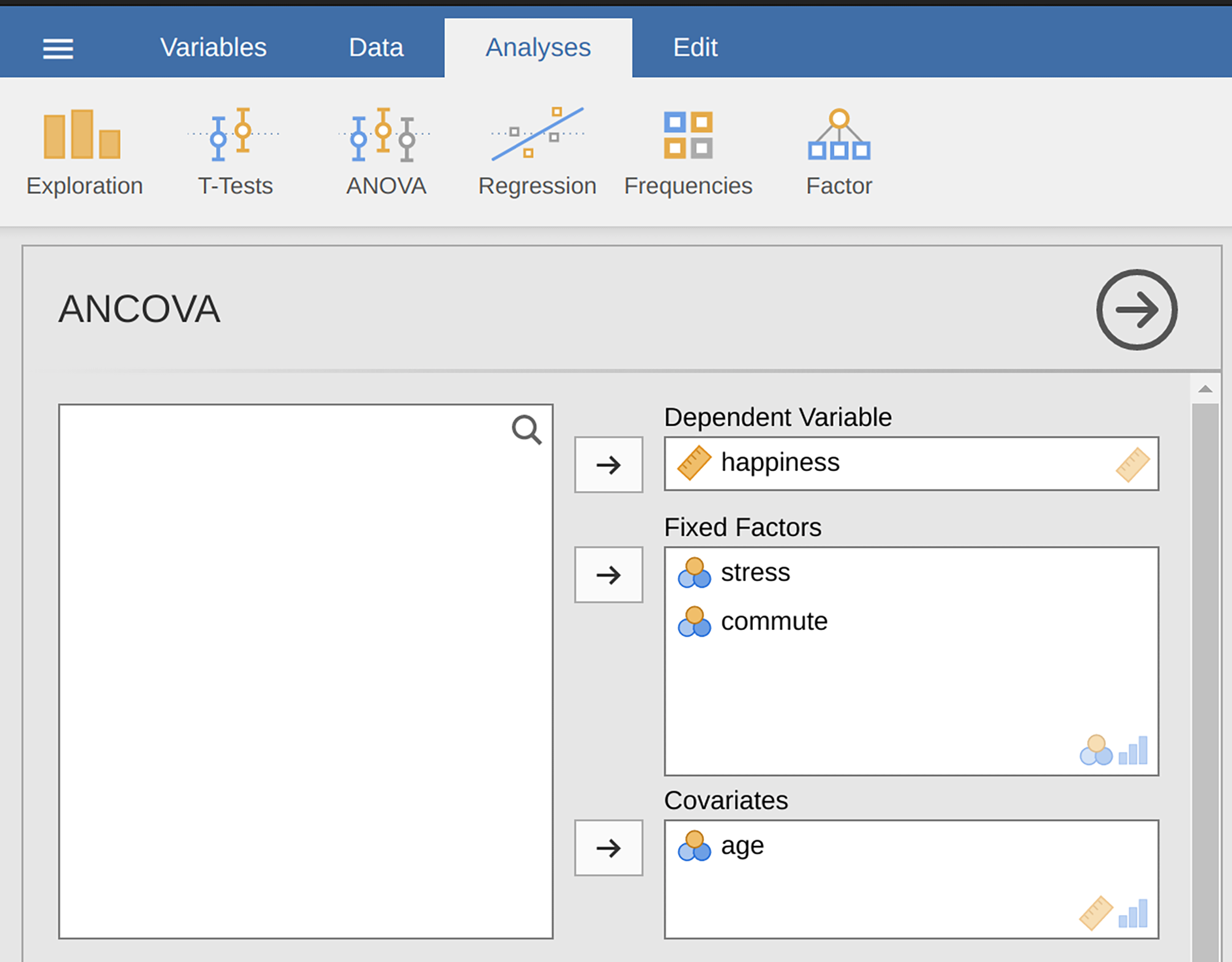
Fig. 177 Options panel showing the variable boxes to assign the Dependent
Variable, Fixed Factors and the Covariates for the ANCOVA in
jamovi
An ANCOVA table showing Tests of Between-Subjects Effects is produced in the
jamovi results panel (Fig. 178). The F-value for the covariate
age is significant at p = 0.023, suggesting that age is an important
predictor of the dependent variable, happiness. When we look at the estimated
marginal mean scores (Fig. 179), adjustments have been made (compared
to an analysis without the covariate) because of the inclusion of the covariate
age in this ANCOVA. A plot (Fig. 180) is a good way of visualising
and interpreting the significant effects.
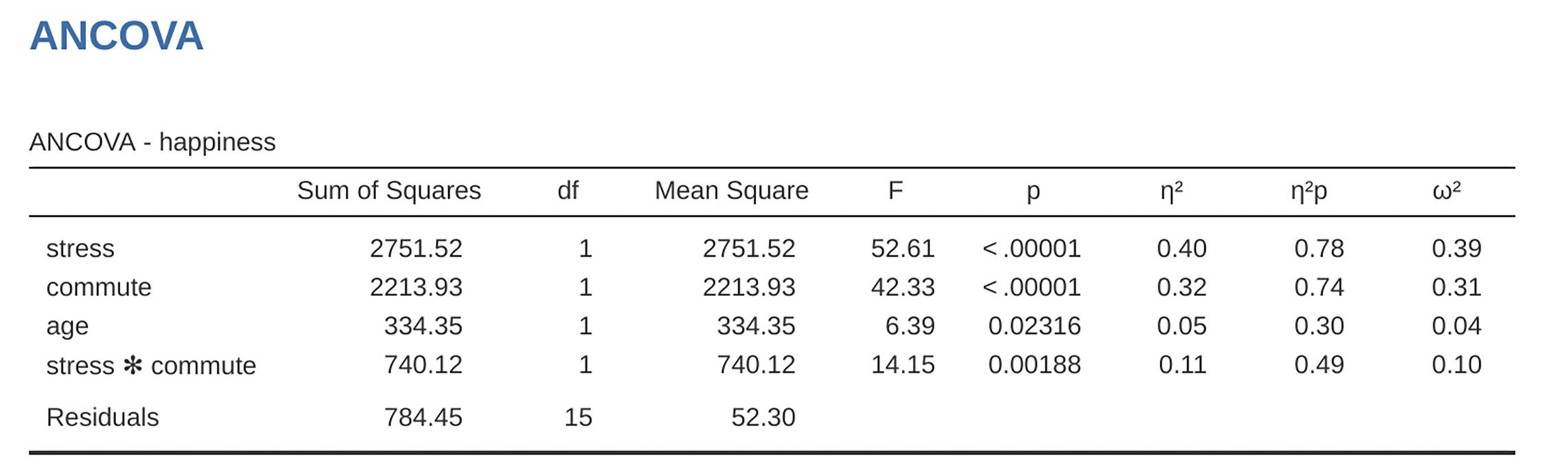
Fig. 178 jamovi ANCOVA output for happiness as a function of stress and commuting method, with age as a covariate
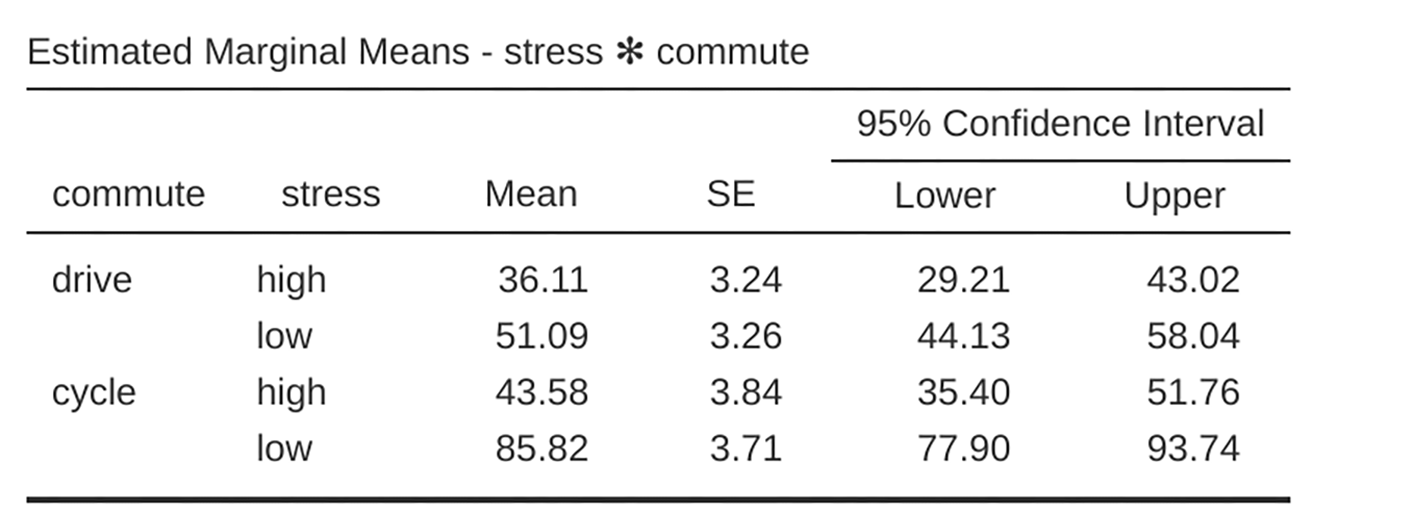
Fig. 179 Table with the Estimated Marginal means within the ANCOVA: Shown are the mean happiness level as a function of stress and commuting method (adjusted for the covariate age) with 95% confidence intervals
The F-value for the main effect stress (52.61) has an associated
probability of p < 0.001. The F-value for the main effect commute
(42.33) has an associated probability of p < 0.001. Since both of these are
less than the probability that is typically used to decide if a statistical
result is significant (p < 0.05) we can conclude that there was a significant
main effect of stress: F(1,15) = 52.61, p < 0.001, and a significant main
effect of commuting method: F(1,15) = 42.33, p < 0.001. A significant
interaction between stress and commuting method was also found: F(1,15) =
14.15, p = 0.002.
In Fig. 180 we can see the adjusted, marginal, mean happiness scores when age is a covariate in an ANCOVA. In this analysis there is a significant interaction effect, whereby people with low stress who cycle to work are happier than people with low stress who drive and people with high stress regardless of whether they cycle or drive to work. There is also a significant main effect of stress – people with low stress are happier than those with high stress. And there is also a significant main effect of commuting behaviour – people who cycle are happier, on average, than those who drive to work.

Fig. 180 Plot with the Estimated Marginal means within the ANCOVA: Shown are the mean happiness level as a function of stress and commuting method
One thing to be aware of is that, if you are thinking of including a covariate
in your ANOVA, there is an additional assumption: the relationship between the
covariate and the dependent variable should be similar for all levels of the
independent variable. This can be checked by adding an interaction term between
the covariate and each independent variable in the jamovi Model → Model
terms option. If the interaction effect is not significant it can be removed.
If it is significant then a different and more advanced statistical technique
might be appropriate (which is beyond the scope of this book so you might want
to consult a friendly statistician).