Forfatter av avsnitt: Danielle J. Navarro and David R. Foxcroft
Analyser
Analyses can be selected from the Analyses ribbon (activate it by clicking
the Analyses-tab at the top of the jamovi window). Here, individual
analyses can be chosen from their respective category (e.g., T-Tests,
ANOVA or Regression). Selecting an analysis will present an options
panel for that particular analysis, allowing you to assign different
variables to different parts of the analysis, and select different options.
At the same time, the results for the analysis will appear in the right results panel and will update in real-time as you make changes to the options. When you have the analysis set up correctly you can dismiss the analysis options by clicking the arrow to the top right of the options panel. If you wish to return to these options, you can click on the results that were produced. In this way, you can return to any analysis that you (or say, a colleague) created earlier.
If you decide you no longer need a particular analysis, you can remove
it with the results context menu. Right-clicking on the analysis results
will bring up a menu and by selecting Analysis and then Remove the
analysis can be removed.
Kopier og lim inn
jamovi produces nice tables and attractive plots that are formatted in
accordance with the American Psychological Association (APA) Publication
Manual. A very useful feature of jamovi is the opportunity to be able to
directly copy and paste these, perhaps into a document, or into an email
to a colleague. To copy results right click on the object of interest and
from the menu select exactly what you want to copy. The menu allows you
to choose to copy only the image or the entire analysis. Selecting
Copy copies the content to the clipboard and this can be pasted into
other programs in the usual way. You can practice this later on when we
do some analyses.
Installere tilleggsmoduler i jamovi
En virkelig flott funksjon i jamovi er muligheten til å installere tilleggsmoduler fra jamovi-biblioteket. Disse tilleggsmodulene er utviklet av jamovi-fellesskapet, dvs. jamovi-brukere og -utviklere som har laget spesielle programvaretillegg som gjør andre, vanligvis mer avanserte, analyser som går utover det som følger med jamovi (selv om disse analysene allerede dekker kanskje 95% av analysene du vil kjøre i psykologi).
To install add-on modules, just click on the large + in the top right of
the jamovi window, select jamovi library and then browse through the
various add-on modules that are available. Choose the one(s) you want, and then
install them, as in Fig. 3. It is that easy. The newly installed
modules can then be accessed from the Analyses ribbon or by clicking on the
the large + and the selecting the analyses you need from the menu that
opens.[1] Try it…
Useful add-on modules to install include the data files for this book,
lsj-data (they can be found in the jamovi file menu (☰; top left-hand
corner → Open → Data Library), the Rj editor, and jTransform
(added under Data; see Sorting, rearranging, merging, transposing data).
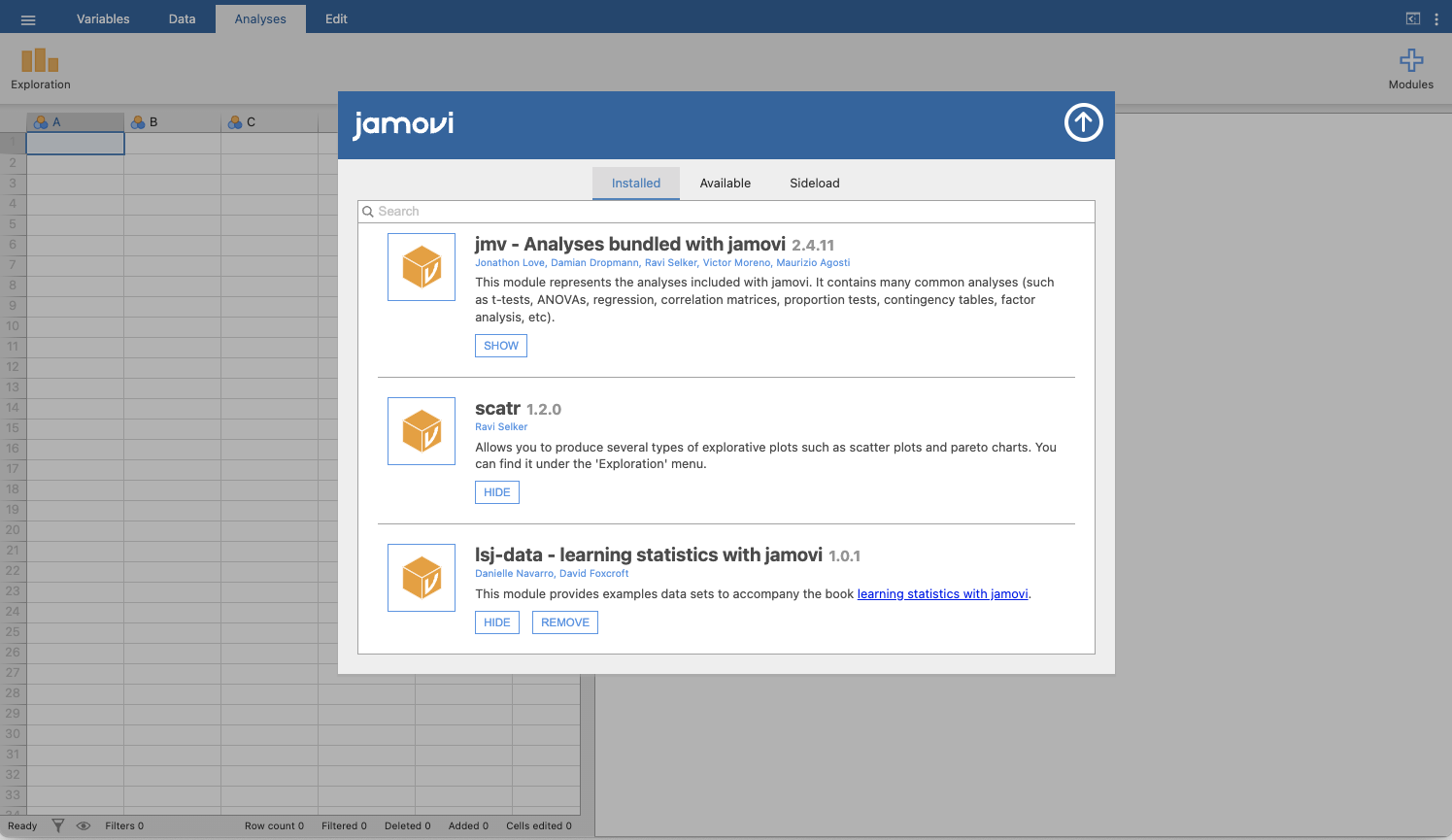
Fig. 3 Installere tilleggsmoduler i jamovi
Syntaksmodus
jamovi also provides an syntax mode. In this mode jamovi produces equivalent
R code for each analysis. To change to syntax mode, select the settings
menu (⋮; top right corner in jamovi) and click the Syntax mode checkbox
there. You can turn off syntax mode by clicking this a second time.
In syntax mode analyses continue to operate as before but now they produce
R syntax. Like all results objects in jamovi, you can right click on these
items (including the R syntax) and copy and paste them, for example into an
R session. To import jamovi-files within an R session, you can use the
function read_omv from the R-package jmvReadWrite (which can be
installed using install.packages("jmvReadWrite") in an R-session. The
package also contains further functions for handling jamovi-files in R
(e.g., write_omv for writing jamovi-files, convert_omv for converting
other file formats to a jamovi-file, or merge_cols_omv for adding columns
from a second data set while matching the two data sets by an index variable).
Help how to use these functions can be obtained by preceding the function name
by a ? (e.g., ?jmvReadWrite::read_omv).
But more on analyses later. First, let us take a more detailed look at the spreadsheet view.