Auteur de la section : Danielle J. Navarro and David R. Foxcroft
An illustrative data set
Suppose you have become involved in a clinical trial in which you are
testing a new antidepressant drug called Joyzepam. In order to
construct a fair test of the drug’s effectiveness, the study involves
three separate drugs to be administered. One is a placebo, and the other
is an existing antidepressant / anti-anxiety drug called Anxifree. A
collection of 18 participants with moderate to severe depression are
recruited for your initial testing. Because the drugs are sometimes
administered in conjunction with psychological therapy, your study
includes nine people undergoing cognitive behavioural therapy (CBT) and
nine who are not. Participants are randomly assigned (doubly blinded, of
course) a treatment, such that there are three CBT people and three
no-therapy people assigned to each of the three drugs. A psychologist
assesses the mood of each person after a three-month run with each drug,
and the overall improvement in each person’s mood is assessed on a scale
ranging from -5 to +5. With that as the study design, let us now load
clinicaltrial data set. It contains the three variables drug
 ,
, therapy and mood.gain  .
.
For the purposes of this chapter, what we are really interested in is the
effect of drug on mood.gain. The first thing to do is calculate some
descriptive statistics and draw some graphs. In Descriptive statistics
we showed you how to do this, and some of the descriptive statistics we can
calculate in jamovi are shown in Fig. 152. As the plot makes clear,
there is a larger improvement in mood for participants in the joyzepam
group than for either the anxifree group or the placebo group. The
anxifree group shows a larger mood gain than the placebo group, but the
difference is not as large. The question that we want to answer is are these
difference “real”, or are they just due to chance?
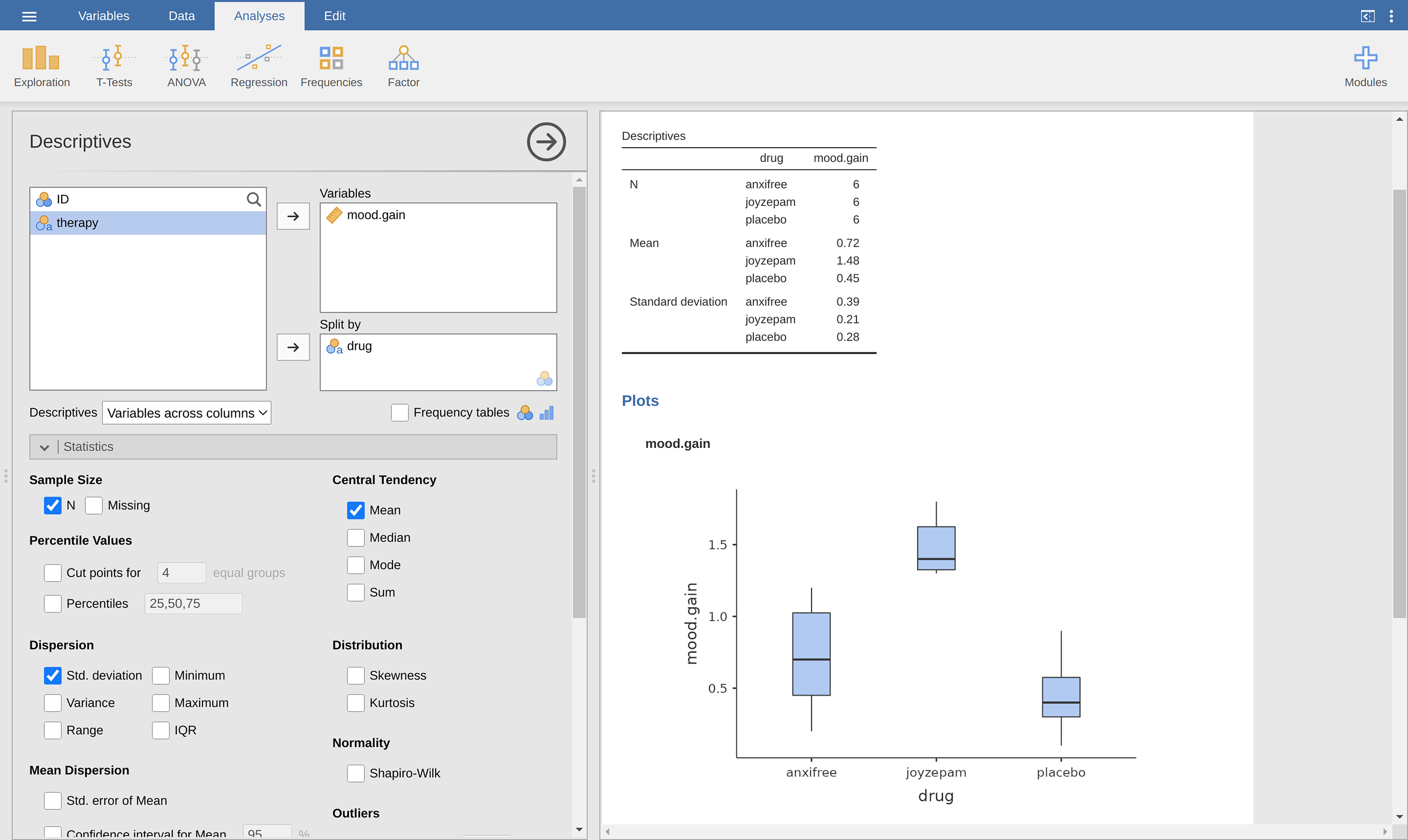
Fig. 152 Descriptives for mood.gain, and box plots by drug administered