Auteur de la section : Danielle J. Navarro and David R. Foxcroft
Estimating a linear regression model
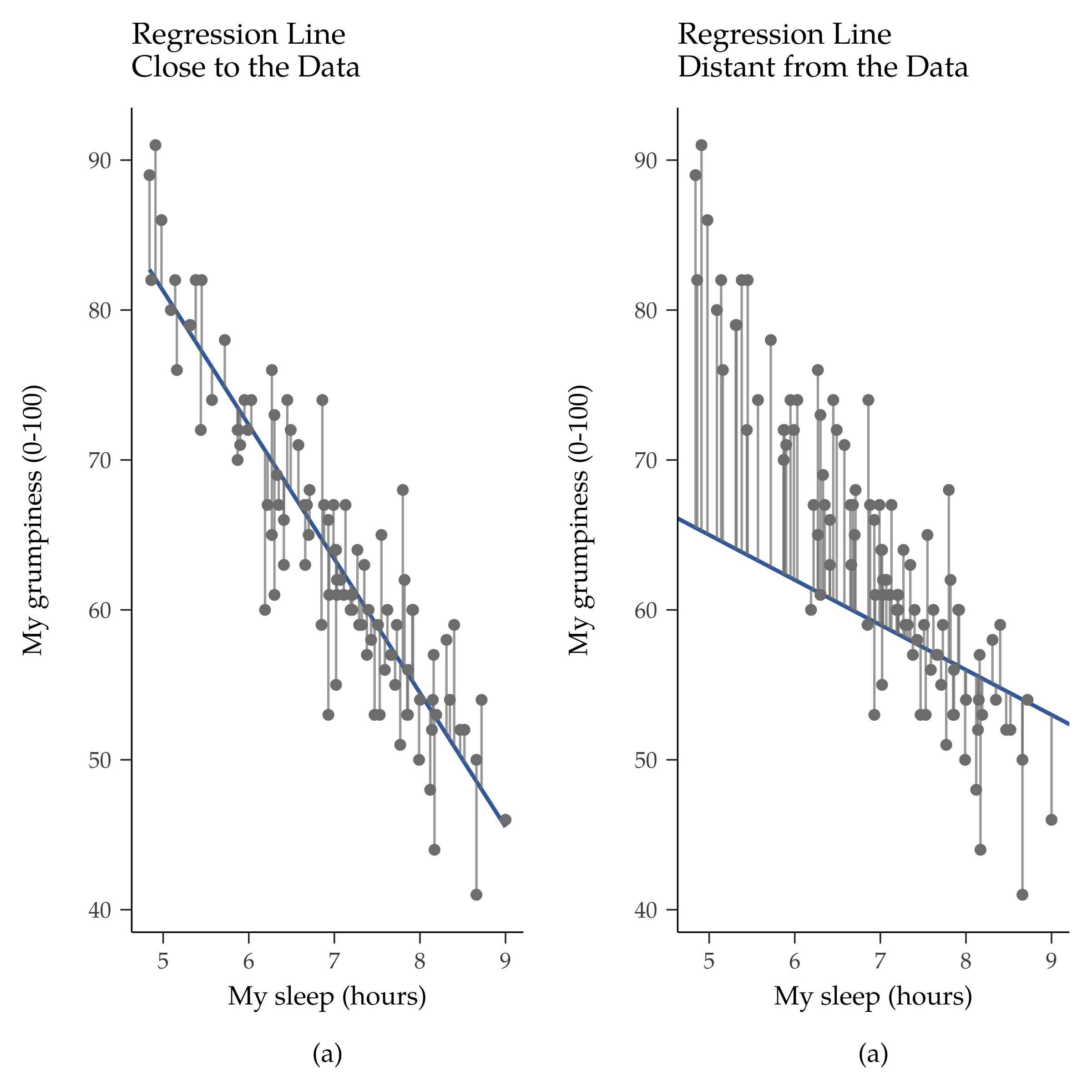
Fig. 135 Depiction of the residuals associated with the best fitting regression line (panel a), and the residuals associated with a poor regression line (panel b). The residuals are much smaller for the good regression line. Again, this is no surprise given that the good line is the one that goes right through the middle of the data.
Let us redraw our pictures but this time I will add some lines to show the size of the residual for all observations. When the regression line is good, our residuals (the lengths of the solid black lines) all look pretty small, as shown in Fig. 135 (a), but when the regression line is a bad one the residuals are a lot larger, as you can see from looking at Fig. 135 (b). Hmm. Maybe what we “want” in a regression model is small residuals. Yes, that does seem to make sense. In fact, I think I will go so far as to say that the “best fitting” regression line is the one that has the smallest residuals. Or, better yet, since statisticians seem to like to take squares of everything why not say that: The estimated regression coefficients, \(\hat{b}_0\) and \(\hat{b}_1\), are those that minimise the sum of the squared residuals, which we could either write as:
or as:
Our regression coefficients are estimates (we are trying to guess the parameters that describe a population!), which is why I have added the little hats, so that we get \(\hat{b}_0\) and \(\hat{b}_1\) rather than b0 and b1. Finally, since there is actually more than one way to estimate a regression model, the more technical name for this estimation process is ordinary least squares (OLS) regression.
We now have a concrete definition for what counts as our “best” choice of regression coefficients, \(\hat{b}_0\) and \(\hat{b}_1\). The natural question to ask next is, if our optimal regression coefficients are those that minimise the sum squared residuals, how do we find these wonderful numbers? The actual answer to this question is complicated and does not help you understand the logic of regression.[1] Instead of showing you the long and tedious way first and then “revealing” the wonderful shortcut that jamovi provides, let us cut straight to the chase and just use jamovi to do all the heavy lifting.
Linear regression in jamovi
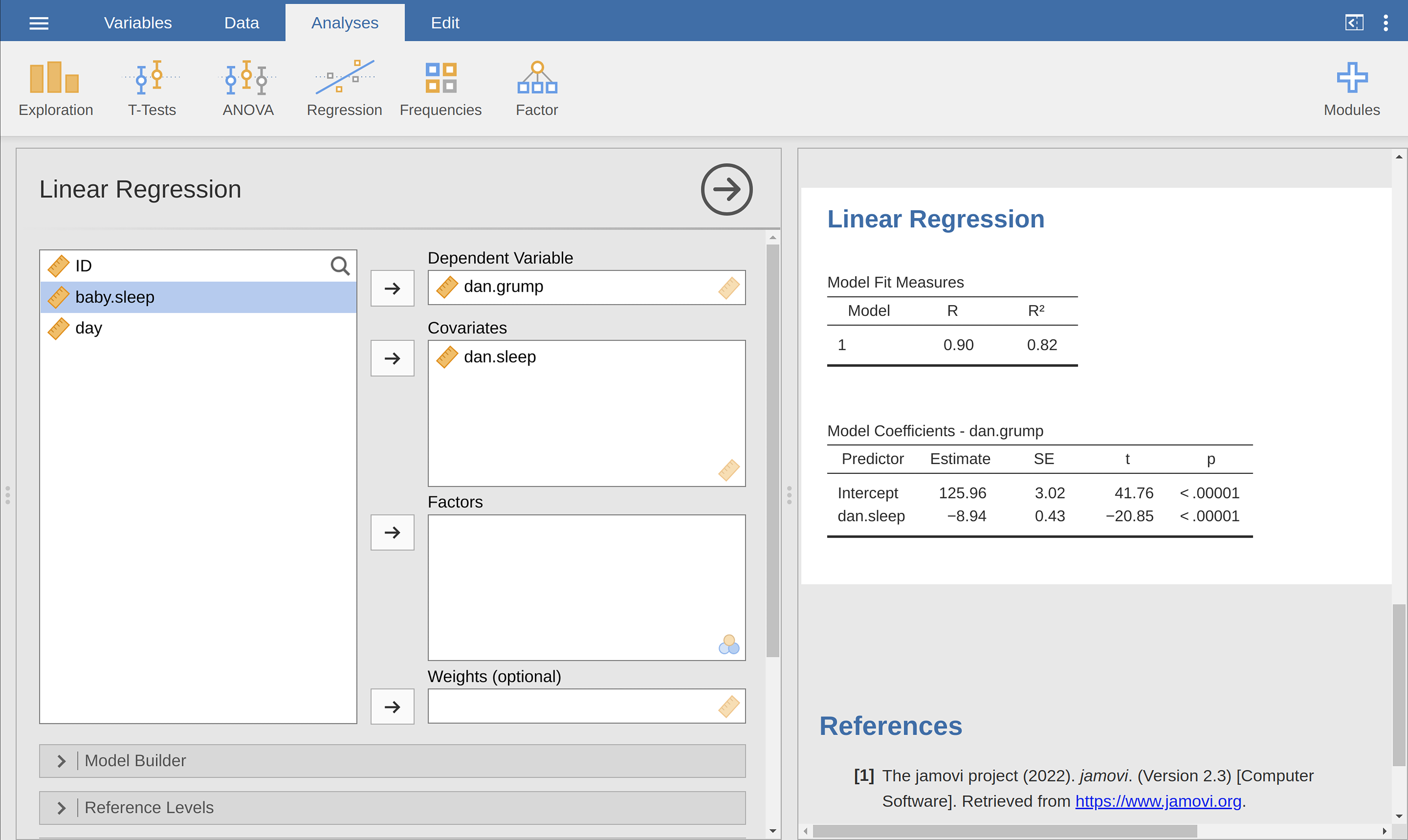
Fig. 136 jamovi screenshot showing a simple linear regression analysis
To run my linear regression, open up the Regression → Linear Regression
analysis in jamovi, using the parenthood data set. Then specify
dani.grump as the Dependent Variable and dani.sleep as the variable
entered in the Covariates box. This gives the results shown in
Fig. 136, showing an intercept \(\hat{b}_0\) = 125.96 and the
slope \(\hat{b}_1\) = -8.94. In other words, the best-fitting regression
line that I plotted in Fig. 135 has this formula:
Interpreting the estimated model
The most important thing to be able to understand is how to interpret these coefficients. Let us start with \(\hat{b}_1\), the slope. If we remember the definition of the slope, a regression coefficient of \(\hat{b}_1\) = -8.94 means that if I increase Xi by 1, then I am decreasing Yi by 8.94. That is, each additional hour of sleep that I gain will improve my mood, reducing my grumpiness by 8.94 grumpiness points. What about the intercept? Well, since \(\hat{b}_0\) corresponds to “the expected value of Yi when Xi equals 0”, it is pretty straightforward. It implies that if I get zero hours of sleep (Xi = 0) then my grumpiness will go off the scale, to an insane value of (Yi = 125.96). Best to be avoided, I think.