Autor des Abschnitts: Danielle J. Navarro and David R. Foxcroft
Der nicht-parametrische ANOVA-Test mit Messwiederholung nach Friedman
Der Friedman-Test ist eine nicht-parametrische Version einer ANOVA mit Messwiederholung und kann anstelle des Kruskall-Wallis-Tests verwendet werden, wenn Unterschiede zwischen drei oder mehr Gruppen  getestet werden, in denen sich dieselben Teilnehmer in jeder Gruppe befinden oder jeder Teilnehmer eng mit Teilnehmern in anderen Bedingungen abgestimmt ist. Ist die abhängige Variable ordinal
  oder ist die Annahme der Normalverteilung nicht erfüllt, kann der Friedman-Test verwendet werden.
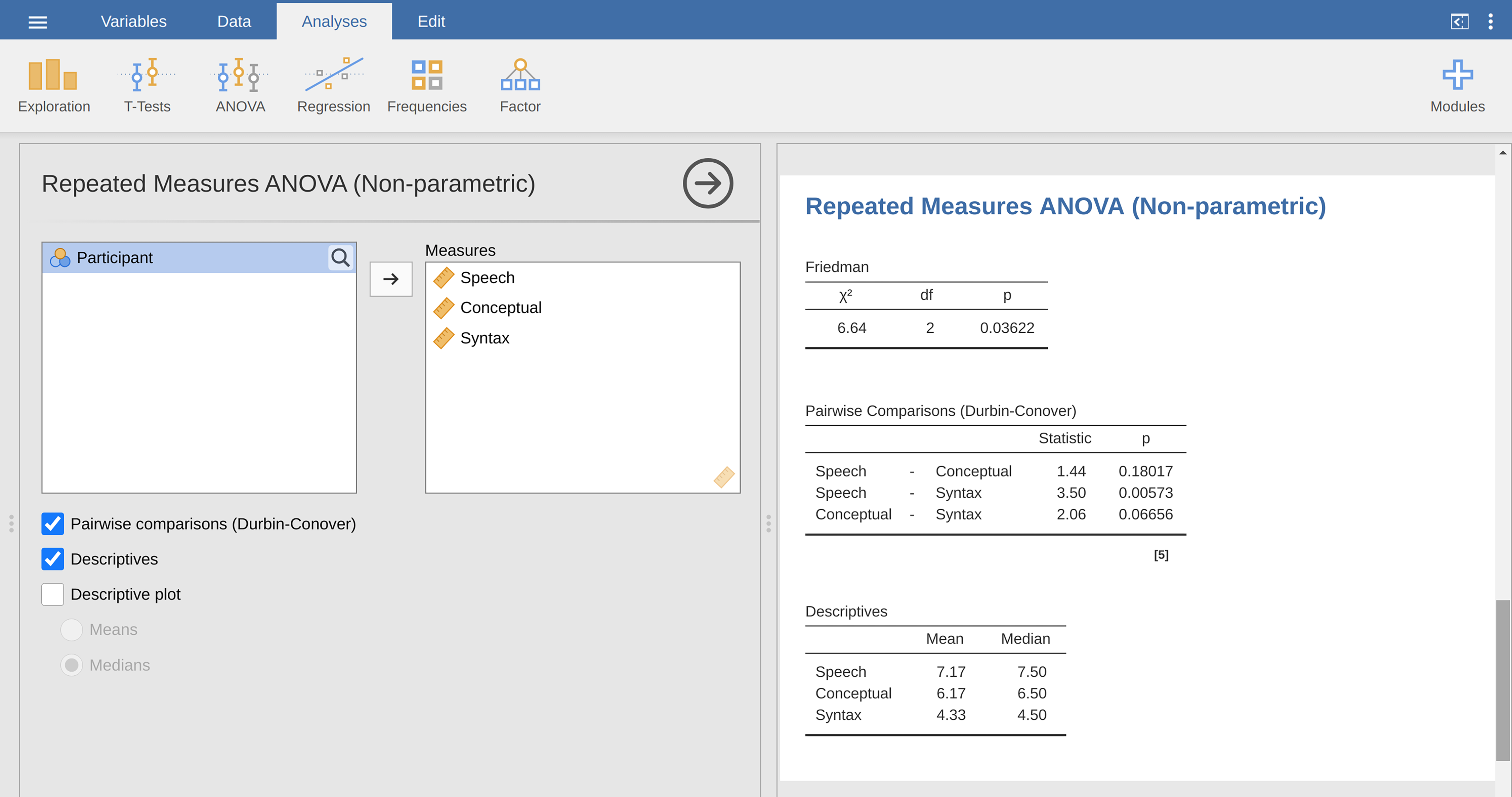
Abb. 165 Dialogfeld mit den Analyseoptionen und die Ergebnisausgabe für die Repeated Measures ANOVA (Non-parametric) in jamovi
As with the Kruskall-Wallis test, the underlying mathematics is complicated, and will not be presented here. For the purpose of this book, it is sufficient to note that jamovi calculates the tie-corrected version of the Friedman test, and in Abb. 165 there is an example using the Broca’s Aphasia data we have already looked at.
It is pretty straightforward to run a Friedman test in jamovi. Just select
Analyses → ANOVA → Repeated Measures ANOVA (Non-parametric),
as in Abb. 165. Then highlight and transfer the names of the repeated
measures variables you wish to compare (Speech, Conceptual, Syntax)
into the Measures: text box. To produce descriptive statistics (means and
medians) for the three repeated measures variables, click on the
Descriptives button.
The jamovi results show descriptive statistics, χ²-value, degrees of freedom, and the p-value (Abb. 165). Since the p-value is less than the level conventionally used to determine significance (p < 0.05), we can conclude that Broca’s Aphasics perform reasonably well on speech production (Md [median] = 7.5) and language comprehension (Md = 6.5) tasks. However, their performance was considerably worse on the syntax task (Md = 4.5), with a significant difference in post-hoc tests between Speech and Syntax task performance.