Forfatter av avsnitt: Danielle J. Navarro and David R. Foxcroft
Utvalgsfordelinger og sentralgrenseteoremet
The law of large numbers is a very powerful tool but it is not going to be good enough to answer all our questions. Among other things, all it gives us is a “long run guarantee”. In the long run, if we were somehow able to collect an infinite amount of data, then the law of large numbers guarantees that our sample statistics will be correct. But as John Maynard Keynes famously argued in economics, a long run guarantee is of little use in real life.
[Det] lange løp er en misvisende rettesnor for dagens situasjon. I det lange løp er vi alle døde. Økonomene setter seg selv en altfor enkel, altfor unyttig oppgave, hvis de i stormfulle årstider bare kan fortelle oss at når stormen for lengst er over, er havet flatt igjen (Keynes, 1923).
Som i økonomi, så også i psykologi og statistikk. Det er ikke nok å vite at vi til slutt vil komme frem til det riktige svaret når vi beregner utvalgsgjennomsnittet. Å vite at et uendelig stort datasett vil fortelle meg den eksakte verdien av populasjonsgjennomsnittet, er en mager trøst når mitt virkelige datasett har en utvalgsstørrelse på N = 100. I virkeligheten må vi altså vite noe om hvordan utvalgsgjennomsnittet oppfører seg når det beregnes ut fra et mer beskjedent datasett!
Utvalgsfordeling av gjennomsnittet
With this in mind, let us abandon the idea that our studies will have sample
sizes of 10 000 and consider instead a very modest experiment indeed. This time
around we will sample N = 5 people and measure their IQ scores. As before, I
can simulate this experiment in jamovi = NORM(100, 15) function, but I only
need five participant IDs this time, not 10 000. These are the five numbers
that jamovi generated:
90 82 94 99 110
The mean IQ in this sample turns out to be exactly 95. Not surprisingly, this is much less accurate than the previous experiment. Now imagine that I decided to replicate the experiment. That is, I repeat the procedure as closely as possible and I randomly sample five new people and measure their IQ. Again, jamovi allows me to simulate the results of this procedure, and generates these five numbers:
78 88 111 111 117
Denne gangen er den gjennomsnittlige IQ-en i utvalget mitt 101. Hvis jeg gjentar eksperimentet 10 ganger, får jeg resultatene som vises i Table 8, og som du kan se, varierer gjennomsnittet i utvalget fra en replikasjon til den neste.
Person 1 |
Person 2 |
Person 3 |
Person 4 |
Person 5 |
Gjennomsnitt i utvalg |
|
|---|---|---|---|---|---|---|
Replikasjon 1 |
90 |
82 |
94 |
99 |
110 |
95.0 |
Replikasjon 2 |
78 |
88 |
111 |
111 |
117 |
101.0 |
Replikasjon 3 |
111 |
122 |
91 |
98 |
86 |
101.6 |
Replikasjon 4 |
98 |
96 |
119 |
99 |
107 |
103.8 |
Replikasjon 5 |
105 |
113 |
103 |
103 |
98 |
104.4 |
Replikasjon 6 |
81 |
89 |
93 |
85 |
114 |
92.4 |
Replikasjon 7 |
100 |
93 |
108 |
98 |
133 |
106.4 |
Replikasjon 8 |
107 |
100 |
105 |
117 |
85 |
102.8 |
Replikasjon 9 |
86 |
119 |
108 |
73 |
116 |
100.4 |
Replikasjon 10 |
95 |
126 |
112 |
120 |
76 |
105.8 |
Now suppose that I decided to keep going in this fashion, replicating this “five IQ scores” experiment over and over again. Every time I replicate the experiment I write down the sample mean. Over time, I would be amassing a new data set, in which every experiment generates a single data point. The first 10 observations from my data set are the sample means listed in Table 8, so my data set starts out like this:
95.0 101.0 101.6 103.8 104.4 …
What if I continued like this for 10 000 replications, and then drew a histogram. Well that is exactly what I did, and you can see the results in Fig. 74. As this picture illustrates, the average of 5 IQ scores is usually between 90 and 110. But more importantly, what it highlights is that if we replicate an experiment over and over again, what we end up with is a distribution of sample means! This distribution has a special name in statistics, it is called the sampling distribution of the mean.
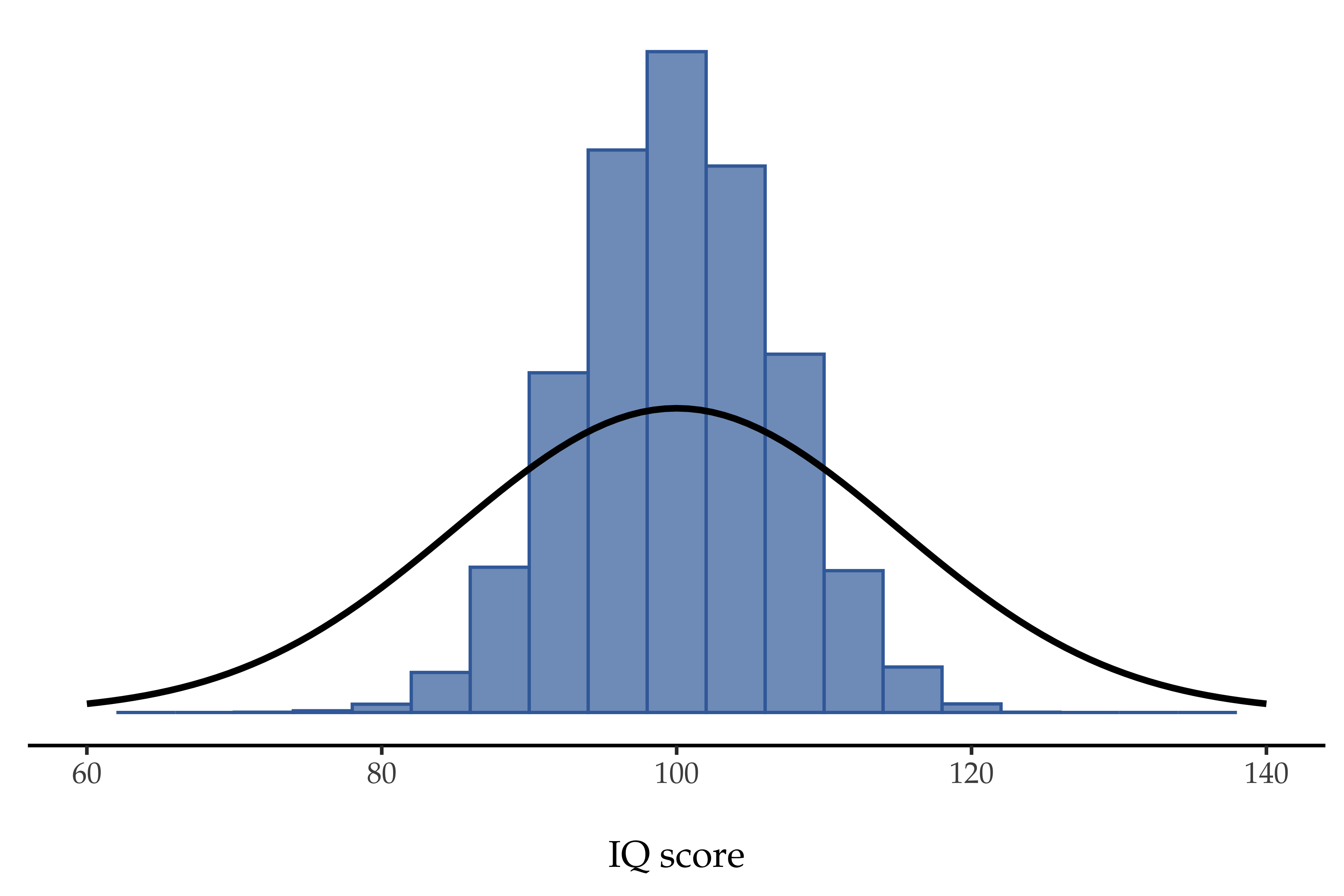
Fig. 74 The sampling distribution of the mean for the “five IQ scores experiment”: If you sample five people at random and calculate their average IQ you will almost certainly get a number between 80 and 120, even though there are quite a lot of individuals who have IQs above 120 or below 80. For comparison, the black line plots the population distribution of IQ scores.
Sampling distributions are another important theoretical idea in statistics, and they are crucial for understanding the behaviour of small samples. For instance, when I ran the very first “five IQ scores” experiment, the sample mean turned out to be 95. What the sampling distribution in Fig. 74 tells us, though, is that the “five IQ scores” experiment is not very accurate. If I repeat the experiment, the sampling distribution tells me that I can expect to see a sample mean anywhere between 80 and 120.
Det finnes utvalgsfordelinger for enhver utvalgsstatistikk!
En ting du må huske på når du tenker på utvalgsfordelinger, er at alle utvalgsstatistikker du måtte ønske å beregne, har en utvalgsfordeling. Anta for eksempel at jeg hver gang jeg replikerte eksperimentet med «fem IQ-skårer», skrev ned den største IQ-skåren i eksperimentet. Dette ville gitt meg et datasett som startet slik:
110 117 122 119 113 …
Doing this over and over again would give me a very different sampling distribution, namely the sampling distribution of the maximum. The sampling distribution of the maximum of 5 IQ scores is shown in Fig. 75. Not surprisingly, if you pick five people at random and then find the person with the highest IQ score, they are going to have an above average IQ. Most of the time you will end up with someone whose IQ is measured in the 100 to 140 range.
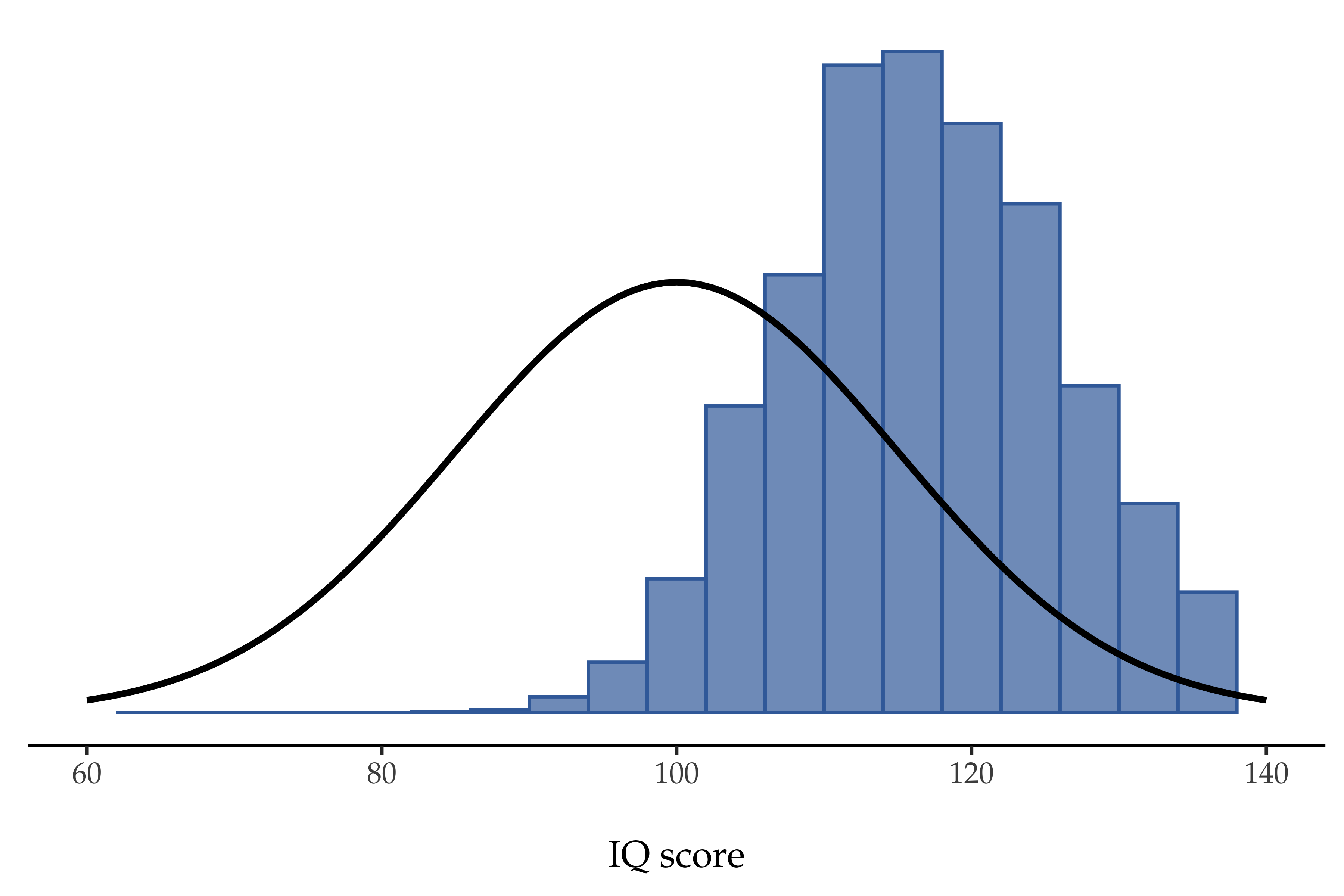
Fig. 75 The sampling distribution of the maximum for the “five IQ scores experiment”: If you sample five people at random and select the one with the highest IQ score you will probably see someone with an IQ between 100 and 140.
Den sentrale grenseteoremet
At this point I hope you have a pretty good sense of what sampling distributions are, and in particular what the sampling distribution of the mean is. In this section I want to talk about how the sampling distribution of the mean changes as a function of sample size. Intuitively, you already know part of the answer. If you only have a few observations, the sample mean is likely to be quite inaccurate. If you replicate a small experiment and recalculate the mean you will get a very different answer. In other words, the sampling distribution is quite wide. If you replicate a large experiment and recalculate the sample mean you will probably get the same answer you got last time, so the sampling distribution will be very narrow. You can see this visually in Fig. 76, showing that the bigger the sample size, the narrower the sampling distribution gets: In panel (a), each data set contained only a single observation, so the mean of each sample is just one person’s IQ score. As a consequence, the sampling distribution of the mean is of course identical to the population distribution of IQ scores. In panel (b), we raise the sample size to 2, and the mean of any one sample tends to be closer to the population mean than a one person’s IQ score, and so the histogram (i.e., the sampling distribution) is a bit narrower than the population distribution. In panel (c), we raise the sample size to 10 (right panel), and we can see that the distribution of sample means tend to be fairly tightly clustered around the true population mean.
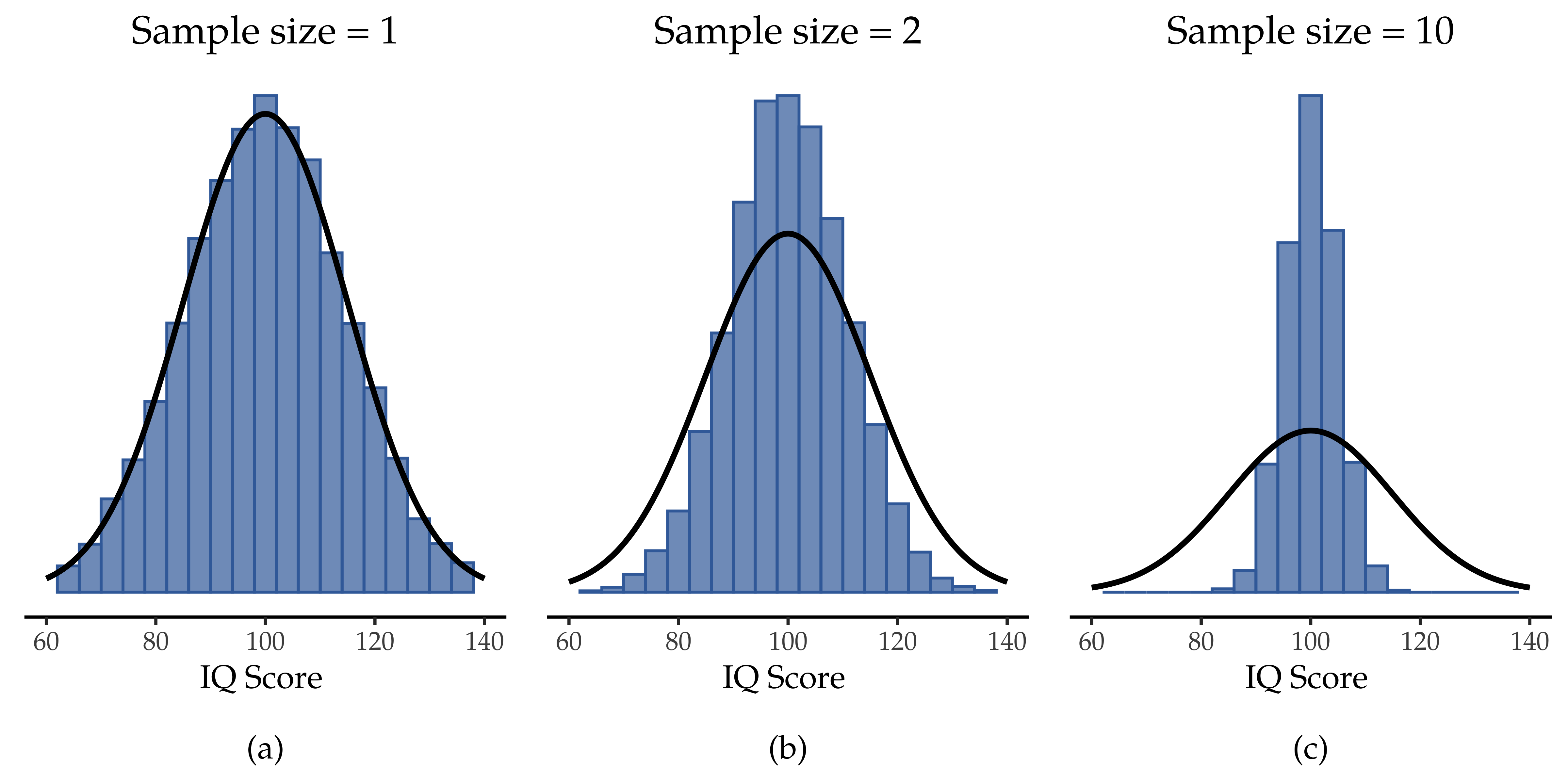
Fig. 76 Illustration of the how sampling distribution of the mean depends on sample size. In each panel I generated 10 000 samples of IQ data and calculated the mean IQ observed within each of these data sets. The histograms in these plots show the distribution of these means (i.e., the sampling distribution of the mean). Each individual IQ score was drawn from a normal distribution with mean 100 and standard deviation 15, which is shown as the solid black line.
We can quantify this effect by calculating the standard deviation of the sampling distribution, which is referred to as the standard error. The standard error of a statistic is often denoted SE, and since we are usually interested in the standard error of the sample mean, we often use the acronym SEM. As you can see just by looking at the picture, as the sample size N increases, the SEM decreases.
Okay, so that is one part of the story. However, there is something I have been glossing over so far. All my examples up to this point have been based on the “IQ scores” experiments, and because IQ scores are roughly normally distributed I have assumed that the population distribution is normal. What if it is not normal? What happens to the sampling distribution of the mean? The remarkable thing is this, no matter what shape your population distribution is, as N increases the sampling distribution of the mean starts to look more like a normal distribution. To give you a sense of this I ran some simulations. To do this, I started with the “ramped” distribution shown in the histogram in Fig. 77 (a). As you can see by comparing the triangular shaped histogram to the bell curve plotted by the black line, the population distribution does not look very much like a normal distribution at all. Next, I simulated the results of a large number of experiments. In each experiment I took N = 2 samples from this distribution, and then calculated the sample mean. Fig. 77 (b) plots the histogram of these sample means (i.e., the sampling distribution of the mean for N = 2). This time, the histogram produces a ∩-shaped distribution. It is still not normal, but it is a lot closer to the black line than the population distribution in Fig. 77 (a). When I increase the sample size to N = 4, the sampling distribution of the mean is very close to normal (Fig. 77, c), and by the time we reach a sample size of N = 8 (Fig. 77, d) it is almost perfectly normal. In other words, as long as your sample size is not tiny, the sampling distribution of the mean will be approximately normal no matter what your population distribution looks like!

Fig. 77 Demonstration of the central limit theorem: In the panel (a), we have a non-normal population distribution, and the remaining panels show the sampling distribution of the mean for samples of size 2 (panel b), 4 (panel c) and 8 (panel d) for data drawn from the distribution in the top-left panel. As you can see, even though the original population distribution is non-normal the sampling distribution of the mean becomes pretty close to normal by the time you have a sample of even four observations.
On the basis of these figures, it seems like we have evidence for all of the following claims about the sampling distribution of the mean:
The mean of the sampling distribution is the same as the mean of the population.
The standard deviation of the sampling distribution (i.e., the standard error) gets smaller as the sample size increases.
The shape of the sampling distribution becomes normal as the sample size increases.
As it happens, not only are all of these statements true, there is a very famous theorem in statistics that proves all three of them, known as the central limit theorem. Among other things, the central limit theorem tells us that if the population distribution has mean µ and standard deviation σ, then the sampling distribution of the mean also has mean µ and the standard error of the mean is:
Because we divide the population standard deviation σ by the square root of the sample size N, the SEM gets smaller as the sample size increases. It also tells us that the shape of the sampling distribution becomes normal.[1]
Dette resultatet er nyttig for alle mulige ting. Det forteller oss hvorfor store eksperimenter er mer reliabel enn små, og fordi det gir oss en eksplisitt formel for standardfeilen, forteller det oss hvor mye mer reliabel et stort eksperiment er. Den forteller oss hvorfor normalfordelingen er, vel, normal. I virkelige eksperimenter er mange av de tingene vi ønsker å måle, faktisk gjennomsnittet av mange forskjellige størrelser (f.eks. er «generell» intelligens, målt ved IQ, et gjennomsnitt av et stort antall «spesifikke» ferdigheter og evner), og når det skjer, bør gjennomsnittsstørrelsen følge en normalfordeling. På grunn av denne matematiske loven dukker normalfordelingen opp igjen og igjen i reelle data.