Автор раздела: Danielle J. Navarro and David R. Foxcroft
How ANOVA works
In order to answer the question posed by our clinicaltrial data we are
going to run a one-way ANOVA. I am going to start by showing you how to
do it the hard way, building the statistical tool from the ground up and
showing you how you could do it if you did not have access to any of the
cool built-in ANOVA functions in jamovi. And I hope you will read it
carefully, try to do it the long way once or twice to make sure you
really understand how ANOVA works.
The experimental design that I described in the previous section strongly suggests that we are interested in comparing the average mood change for the three different drugs. In that sense, we are talking about an analysis similar to the t-test (chapter Comparing two means) but involving more than two groups. If we let µP denote the population mean for the mood change induced by the placebo, and let µA and µJ denote the corresponding means for our two drugs, Anxifree and Joyzepam, then the (somewhat pessimistic) null hypothesis that we want to test is that all three population means are identical. That is, neither of the two drugs is any more effective than a placebo. We can write out this null hypothesis as:
H0: it is true that µP = µA = µJ
As a consequence, our alternative hypothesis is that at least one of the three different treatments is different from the others. It is a bit tricky to write this mathematically, because (as we will discuss) there are quite a few different ways in which the null hypothesis can be false. So for now we will just write the alternative hypothesis like this:
H1: it is NOT true that µP = µA = µJ
This null hypothesis is a lot trickier to test than any of the ones we have seen previously. Given the title of this chapter, a sensible guess would be to “do an ANOVA”, but it is not particularly clear why an “analysis of variances” will help us learn anything useful about the means. In fact, this is one of the biggest conceptual difficulties that people have when first encountering ANOVA. To see how this works, let us start by talking about variances, specifically between group variability and within-group variability (Рис. 153).
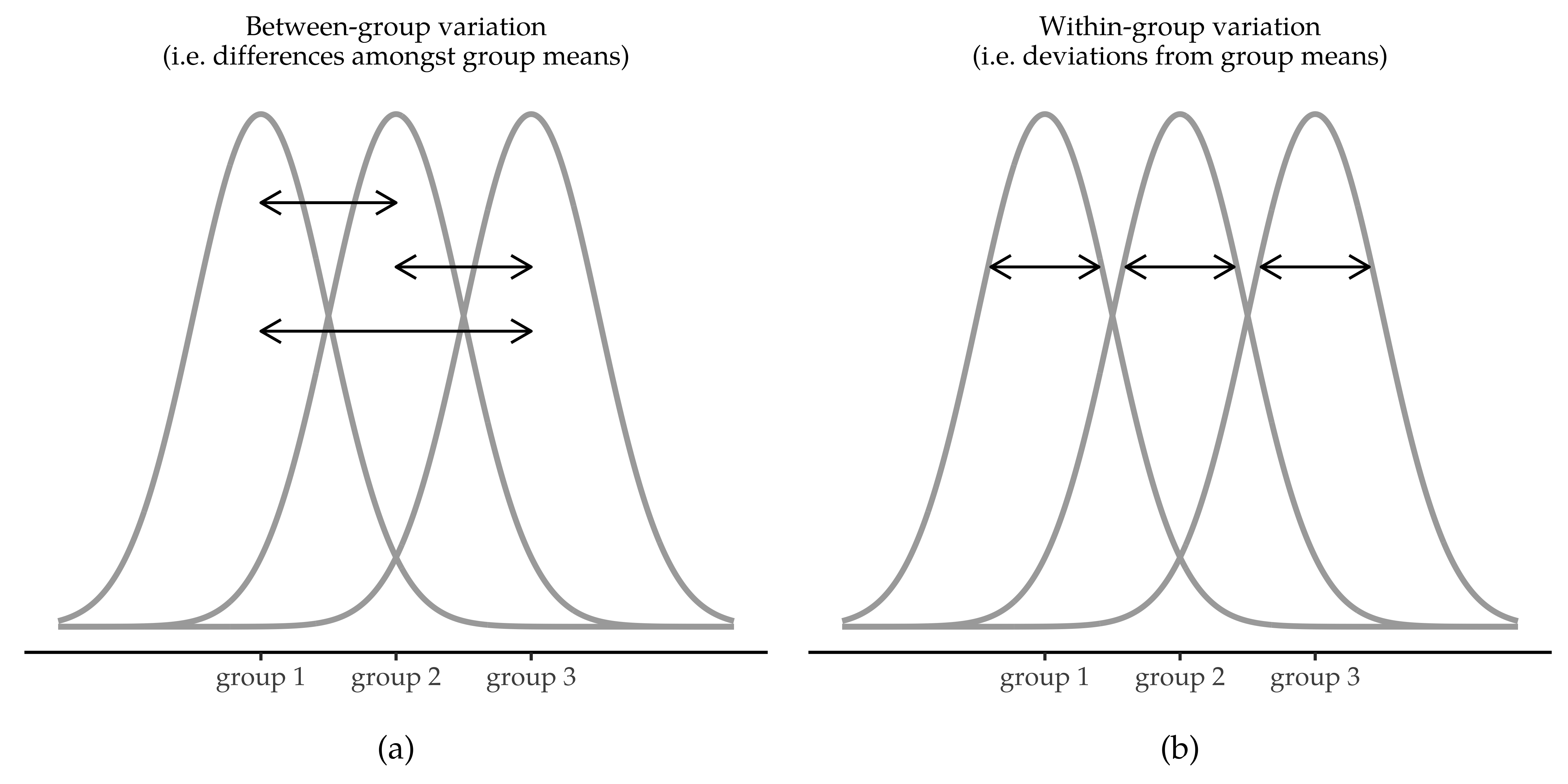
Рис. 153 Graphical illustration of “between-groups” (left panel) and “within-groups” variation (right panel). In the left panel, the arrows show the differences in the group means. In the right panel, the arrows highlight the variability within each group.
Two formulas for the variance of Y
First, let us start by introducing some notation. We will use G to refer to
the total number of groups. For our data set there are three drugs, so there
are G = 3 groups. Next, we will use N to refer to the total sample size;
there are a total of N = 18 people in our data set. Similarly, let us use
Nk to denote the number of people in the k-th group. In our
clinicaltrial data set, the sample size is Nk = 6` for all three
groups.[1] Finally, we will use Y to denote the outcome variable. In our
case, Y refers to mood change. Specifically, we will use Yik to refer to
the mood change experienced by the i-th member of the k-th group.
Similarly, we will use Ȳ to be the average mood change, taken across all 18
people in the experiment, and Ȳk to refer to the average mood change
experienced by the 6 people in group k.
Now that we have got our notation sorted out we can start writing down formulas. To start with, let us recall the formula for the variance that we used way back in those kinder days when we were just doing descriptive statistics. The sample variance of Y is defined as follows:
This formula looks pretty much identical to the formula for the variance. The only difference is that this time around I have got two summations here: I am summing over groups (i.e., values for k) and over the people within the groups (i.e., values for :`i). This is purely a cosmetic detail. If I had instead used the notation Yp to refer to the value of the outcome variable for person p in the sample, then I would only have a single summation. The only reason that we have a double summation here is that I have classified people into groups, and then assigned numbers to people within groups.
A concrete example might be useful here. Let us consider this table, in which we have a total of N = 5 people sorted into G = 2 groups. Arbitrarily, let us say that the “cool” people are group 1 and the “uncool” people are group 2. It turns out that we have three cool people (N1 = 3) and two uncool people (N2 = 2).
name |
person |
group |
group num. |
index in group |
grumpiness |
p |
k |
i |
Yik or Yp |
||
Ann |
1 |
cool |
1 |
1 |
20 |
Ben |
2 |
cool |
1 |
2 |
55 |
Cat |
3 |
cool |
1 |
3 |
21 |
Tim |
4 |
uncool |
2 |
1 |
91 |
Egg |
5 |
uncool |
2 |
2 |
22 |
Notice that I have constructed two different labelling schemes here. We have a “person” variable p so it would be perfectly sensible to refer to Yp as the grumpiness of the p-th person in the sample. For instance, the table shows that Tim is the fourth so we would say p = 4. So, when talking about the grumpiness Y of this “Tim” person, whoever he might be, we could refer to his grumpiness by saying that Yp = 91, for person p = 4. However, that is not the only way we could refer to Tim. As an alternative we could note that Tim belongs to the “uncool” group (k = 2), and is in fact the first person listed in the “uncool” group (i = 1). So it is equally valid to refer to Tim’s grumpiness by saying that Yik = 91, where k = 2 and i = 1.
In other words, each person p corresponds to a unique ik combination, and so the formula that I gave above is actually identical to our original formula for the variance, which would be:
In both formulas, all we are doing is summing over all of the observations in the sample. Most of the time we would just use the simpler Yp notation; the equation using Yp is clearly the simpler of the two. However, when doing an ANOVA it is important to keep track of which participants belong in which groups, and we need to use the Yik notation to do this.
From variances to sums of squares
Okay, now that we have got a good grasp on how the variance is calculated, let us define something called the total sum of squares, which is denoted SStot. This is very simple. Instead of averaging the squared deviations, which is what we do when calculating the variance, we just add them up.
So the formula for the total sum of squares is almost identical to the formula for the variance:
When we talk about analysing variances in the context of ANOVA, what we are really doing is working with the total sums of squares rather than the actual variance. One very nice thing about the total sum of squares is that we can break it up into two different kinds of variation.
First, we can talk about the within-group sum of squares, in which we look to see how different each individual person is from their own group mean:
where Ȳk is a group mean. In our example, Ȳk would be the average mood change experienced by those people given the k-th drug. So, instead of comparing individuals to the average of all people in the experiment, we are only comparing them to those people in the the same group. As a consequence, you would expect the value of SSw to be smaller than the total sum of squares, because it is completely ignoring any group differences, i.e., whether the drugs will have different effects on people’s moods.
Next, we can define a third notion of variation which captures only the between-groups differences. We do this by looking at the differences between-groups means Ȳk and grand mean Ȳ.
In order to quantify the extent of this variation, what we do is calculate the between-group sum of squares:
It is not too difficult to show that the total variation among people in the experiment SStot is actually the sum of the between-groups differences SSb and the variation inside the groups SSw. That is:
SSw + SSb = SStot
We have discovered that the total variability associated with the outcome variable (SStot) can be mathematically carved up into the sum of “the variation due to the differences in the sample means for the different groups” (SSb) plus “all the rest of the variation” (SSw).[2]
How does that help me find out whether the groups have different population means? Um. Wait. Hold on a second. Now that I think about it, this is exactly what we were looking for. If the null hypothesis is true then you would expect all the sample means to be pretty similar to each other, right? And that would imply that you would expect SSb to be really small, or at least you would expect it to be a lot smaller than “the variation associated with everything else”, SSw. Hmm. I detect a hypothesis test coming on.
From sums of squares to the F-test
As we saw in the last section, the qualitative idea behind ANOVA is to compare the two sums of squares values SSb and SSw to each other. If the between-group variation SSb is large relative to the within-group variation SSw then we have reason to suspect that the population means for the different groups are not identical to each other. In order to convert this into a workable hypothesis test, there is a little bit of “fiddling around” needed. What I will do is first show you what we do to calculate our test statistic, the F-ratio, and then try to give you a feel for why we do it this way.
In order to convert our SS values into an F-ratio the first thing we need to calculate is the degrees of freedom associated with the SSb and SSw values. As usual, the degrees of freedom corresponds to the number of unique “data points” that contribute to a particular calculation, minus the number of “constraints” that they need to satisfy. For the within-groups variability what we are calculating is the variation of the individual observations (N data points) around the group means (G constraints). In contrast, for the between groups variability we are interested in the variation of the group means (G data points) around the grand mean (1 constraint). Therefore, the degrees of freedom here are:
Okay, that seems simple enough. What we do next is convert our summed squares value into a “mean squares” value, which we do by dividing by the degrees of freedom:
Finally, we calculate the F-ratio by dividing the between-groups MS by the within-groups MS:
At a very general level, the intuition behind the F-statistic is straightforward. Bigger values of F means that the between-groups variation is large relative to the within-groups variation. As a consequence, the larger the value of F the more evidence we have against the null hypothesis. But how large does F have to be in order to actually reject H0? In order to understand this, you need a slightly deeper understanding of what ANOVA is and what the mean squares values actually are.
The next section discusses that in a bit of detail, but for readers that are not interested in the details of what the test is actually measuring I will cut to the chase. In order to complete our hypothesis test we need to know the sampling distribution for F if the null hypothesis is true. Not surprisingly, the sampling distribution for the F-statistic under the null hypothesis is an F-distribution. If you recall our discussion of the F-distribution in chapter Introduction to probability, the F-distribution has two parameters, corresponding to the two degrees of freedom involved. The first one df1 is the between-groups degrees of freedom dfb, and the second one df2 is the within-groups degrees of freedom dfw.
A summary of all the key quantities involved in a one-way ANOVA, including the formulas showing how they are calculated, is shown in Таблица 16.
df |
sum of squares |
mean squares |
F-statistic |
p-value |
|
|---|---|---|---|---|---|
between groups |
dfb = G - 1 |
SSb = \(\displaystyle\sum_{k = 1} ^ G N_k(\bar{Y}_k - \bar{Y}) ^ 2\) |
MSb = SSb / dfb |
F = MSb / MSw |
[complicated] |
within groups |
dfw = N - G |
SSw = \(\displaystyle\sum_{k = 1} ^ G \displaystyle\sum_{i = 1} ^ {N_k} ({Y}_{ik} - \bar{Y}_k) ^ 2\) |
MSw = SSw / dfw |
– |
– |
The model for the data and the meaning of F
At a fundamental level ANOVA is a competition between two different statistical models, H0 and H1. When I described the null and alternative hypotheses at the start of the section, I was a little imprecise about what these models actually are. I will remedy that now, though you probably will not like me for doing so. If you recall, our null hypothesis was that all of the group means are identical to one another. If so, then a natural way to think about the outcome variable Yik is to describe individual scores in terms of a single population mean µ, plus the deviation from that population mean. This deviation is usually denoted ϵik and is traditionally called the error or residual associated with that observation. Be careful though. Just like we saw with the word “significant”, the word “error” has a technical meaning in statistics that is not quite the same as its everyday English definition. In everyday language, “error” implies a mistake of some kind, but in statistics it does not (or at least, not necessarily). With that in mind, the word “residual” is a better term than the word “error”. In statistics both words mean “leftover variability”, that is “stuff” that the model can not explain.
In any case, here is what the null hypothesis looks like when we write it as a statistical model:
Yik = µ + ϵik
where we make the assumption (discussed later) that the residual values ϵik are normally distributed, with mean 0 and a standard deviation σ that is the same for all groups. To use the notation that we introduced in chapter Introduction to probability we would write this assumption like this:
ϵik ~ Normal(0, σ²)
What about the alternative hypothesis, H1? The only difference between the null hypothesis and the alternative hypothesis is that we allow each group to have a different population mean. So, if we let µk denote the population mean for the k-th group in our experiment, then the statistical model corresponding to H1 is:
Yik = µk + ϵik
where, once again, we assume that the error terms are normally distributed with mean 0 and standard deviation σ. That is, the alternative hypothesis also assumes that:
ϵ ~ Normal(0, σ²)
Okay, now that we have described the statistical models underpinning H0 and H1 in more detail, it is now pretty straightforward to say what the mean square values are measuring, and what this means for the interpretation of F. I will not bore you with the proof of this but it turns out that the within-groups mean square, MSw, can be viewed as an estimator (in the technical sense, chapter Estimating unknown quantities from a sample) of the error variance σ². The between-groups mean square MSb is also an estimator, but what it estimates is the error variance plus a quantity that depends on the true differences among the group means. If we call this quantity Q, then we can see that the F-statistic is basically:[3]
where the true value Q = 0 if the null hypothesis is true, and Q > 0 if the alternative hypothesis is true (Hays, 1994, Ch. 10). Therefore, at a bare minimum the F-value must be larger than 1 to have any chance of rejecting the null hypothesis. Note that this does not mean that it is impossible to get an F-value less than 1. What it means is that if the null hypothesis is true the sampling distribution of the F-ratio has a mean of 1,[4] and so we need to see F-values larger than 1 in order to safely reject the null hypothesis.
To be a bit more precise about the sampling distribution, notice that if the null hypothesis is true, both MSb and MSw are estimators of the variance of the residuals ϵik. If those residuals are normally distributed, then you might suspect that the estimate of the variance of ϵik is χ²-distributed, because (as discussed in Other useful distributions) that is what a χ²-distribution is: it is what you get when you square a bunch of normally-distributed things and add them up. And since the F-distribution is (again, by definition) what you get when you take the ratio between two things that are χ² distributed, we have our sampling distribution. Obviously, I am glossing over a whole lot of stuff when I say this, but in broad terms, this really is where our sampling distribution comes from.
A worked example
The previous discussion was fairly abstract and a little on the
technical side, so I think that at this point it might be useful to see
a worked example. For that, let us go back to the clinicaltrial data set
that was introduced earlier in the chapter. The descriptive statistics
that we calculated at the beginning tell us our group means: An average
mood gain of 0.45 for the placebo, 0.72 for Anxifree, and 1.48 for Joyzepam.
With that in mind, let us party like it is 1899[5] and start doing some
pencil and paper calculations. I will only do this for the first five
observations because it is not bloody 1899 and I am very lazy. Let us start
by calculating SSw, the within-group sums of squares. First, let us draw
up a nice table to help us with our calculations:
group |
outcome |
k |
Yik |
placebo |
0.5 |
placebo |
0.3 |
placebo |
0.1 |
anxifree |
0.6 |
anxifree |
0.4 |
At this stage, the only thing I have included in the table is the raw data
itself. That is, the grouping variable (i.e., drug) and outcome
variable (i.e., mood.gain) for each person. Note that the outcome
variable here corresponds to the Yik value in our equation
previously. The next step in the calculation is to write down, for each
person in the study, the corresponding group mean, Ȳk.
This is slightly repetitive but not particularly difficult since we
already calculated those group means when doing our descriptive
statistics:
group |
outcome |
group mean |
k |
Yik |
Ȳk |
placebo |
0.5 |
0.45 |
placebo |
0.3 |
0.45 |
placebo |
0.1 |
0.45 |
anxifree |
0.6 |
0.72 |
anxifree |
0.4 |
0.72 |
Now that we have written those down, we need to calculate, again for every person, the deviation from the corresponding group mean. That is, we want to subtract Yik - Ȳk. After we have done that, we need to square everything. When we do that, here is what we get:
group |
outcome |
group mean |
dev. from group mean |
squared deviation |
k |
Yik |
Ȳk |
(Yik - Ȳk) |
(Yik - Ȳk)² |
placebo |
0.5 |
0.45 |
0.05 |
0.0025 |
placebo |
0.3 |
0.45 |
-0.15 |
0.0225 |
placebo |
0.1 |
0.45 |
-0.35 |
0.1225 |
anxifree |
0.6 |
0.72 |
-0.12 |
0.0136 |
anxifree |
0.4 |
0.72 |
-0.32 |
0.1003 |
The last step is equally straightforward. In order to calculate the within-group sum of squares we just add up the squared deviations across all observations:
SSw = 0.0025 + 0.0225 + 0.1225 + 0.0136 + 0.1003 = 0.2614
Of course, if we actually wanted to get the right answer we would need to do this for all 18 observations in the data set, not just the first five. We could continue with the pencil and paper calculations if we wanted to, but it is pretty tedious. Alternatively, it is not too hard to do this in jamovi.
Go to an empty column (at the end of the data set) and double click on the column header, choose
New computed variableand entersq_res_wthin the first line and the formula(mood.gain - VMEAN(mood.gain, group_by = drug)) ^ 2in the line starting with=(next to the fx).mood.gainrepresents Yik,VMEAN(mood.gain, group_by = drug)the group mean Ȳk. This difference (third column in the table above) is then squared and it is therefore not much surprise to see that the values are (apart from rounding errors) identical to those in the last column of the table above.
Okay. Now that we have calculated the within-groups variation, SSw, it is time to turn our attention to the between-group sum of squares, SSb. The calculations for this case are very similar. The main difference is that instead of calculating the differences between an observation Yik and a group mean Ȳk for all of the observations, we calculate the differences between-group means Ȳk and the grand mean Ȳ (in this case 0.88) for all of the groups.
group |
group mean |
grand mean |
deviation |
squared deviations |
k |
Ȳk |
Ȳ |
Ȳk - Ȳ |
(Ȳk - Ȳ)² |
placebo |
0.45 |
0.88 |
-0.43 |
0.19 |
anxifree |
0.72 |
0.88 |
-0.16 |
0.03 |
joyzepam |
1.48 |
0.88 |
0.60 |
0.36 |
We create another computed variable with the name
sq_res_btwand(VMEAN(mood.gain, group_by = drug) - VMEAN(mood.gain)) ^ 2as formula. The termVMEAN(mood.gain, group_by = drug)represents the group mean Ȳk, andVMEAN(mood.gain)the grand mean Ȳ. Again, we find that the values for that variable are the same as in the last column of the table above: the first three rows representplacebo, followed by three lines withanxifreeand three lines withjoyzepam; the next nine lines are a repetition of the first nine ones.
However, for the between-group calculations we need to multiply each of these squared deviations by Nk, the number of observations in the group. We do this because every observation in the group (all Nk of them) is associated with a between-group difference. So if there are six people in the placebo group and the placebo group mean differs from the grand mean by 0.19, then the total between-group variation associated with these six people is 6 · 0.19 = 1.14. So we have to extend our little table of calculations:
group |
… |
squared deviations |
sample size |
weighted squared deviat. |
k |
… |
(Ȳk - Ȳ)² |
Nk |
Nk · (Ȳk - Ȳ)² |
placebo |
… |
0.19 |
6 |
1.14 |
anxifree |
… |
0.03 |
6 |
0.18 |
joyzepam |
… |
0.36 |
6 |
2.16 |
And so now our between-group sum of squares is obtained by summing these “weighted squared deviations” over all three groups in the study:
SSb = 1.14 + 0.18 + 2.16 = 3.48
As you can see, the between-group calculations are a lot shorter (when calculated b hand).
In jamovi, we can calculate these sums, i.e., the values for SSb and SSw, by clicking
Descriptives→Descriptive Statistics, then movingsq_res_wthandsq_res_btwto theVariablesbox, and finally selectingSumfrom theStatisticsdrop-down menu. The sum ofsq_res_wth(SSw) has a value of 1.392,sq_res_wth(SSb) a value of 3.453 (just rounding errors away from the 3.48 we calculated above).
Now that we have calculated our sums of squares values, SSb and SSw, the rest of the ANOVA is pretty painless. The next step is to calculate the degrees of freedom. Since we have G = 3 groups and N = 18 observations in total our degrees of freedom can be calculated by simple subtraction:
dfb = G - 1 = 2 dfw = N - G = 15
Next, since we have now calculated the values for the sums of squares and the degrees of freedom, for both the within-groups variability and the between-groups variability, we can obtain the mean square values by dividing one by the other:
We are almost done. The mean square values can be used to calculate the F-value, which is the test statistic that we are interested in. We do this by dividing the between-groups MS value by the within-groups MS value.[6]
Now that we have our test statistic, the last step is to find out whether the test itself gives us a significant result. As discussed in chapter Hypothesis testing back in the “old days” what we would do is open up a statistics textbook or flick to the back section which would actually have a huge lookup table and we would find the threshold F-value corresponding to a particular value of α (the null hypothesis rejection region), e.g., 0.05, 0.01 or 0.001, for 2 and 15 degrees of freedom. Doing it this way would give us a threshold F-value for an α of 0.001 of 11.34. As this is less than our calculated F-value we say that p < 0.001. Nowadays fancy stats software calculates the exact p-value for you, which is 0.000086. So, unless we are being extremely conservative about our Type I error rate, we are pretty much guaranteed to reject the null hypothesis.
At this point, we are basically done. Having completed our calculations,
it is traditional to organise all these numbers into an ANOVA table like
the one in Таблица 16. For our clinicaltrial data,
the ANOVA table would look like this:[7]
df |
sum of squares |
mean squares |
F-statistic |
p-value |
|
|---|---|---|---|---|---|
between groups |
2 |
3.453 |
1.727 |
18.611 |
0.000086 |
within groups |
15 |
1.392 |
0.093 |
– |
– |
These days, you will probably never have much reason to want to construct one of these tables yourself, but you will find that almost all statistical software (jamovi included) tends to organise the output of an ANOVA into a table like this, so it is a good idea to get used to reading them. However, although the software will output a full ANOVA table, there is almost never a good reason to include the whole table in your write up. A pretty standard way of reporting this result would be to write something like this:
One-way ANOVA showed a significant effect of drug on mood gain: F(2,15) = 18.61, p < 0.001.
Sigh. So much work for one short sentence.